


Grain Silo Design for High-Moisture Corn and Specialty Grains
May Wed, 2026
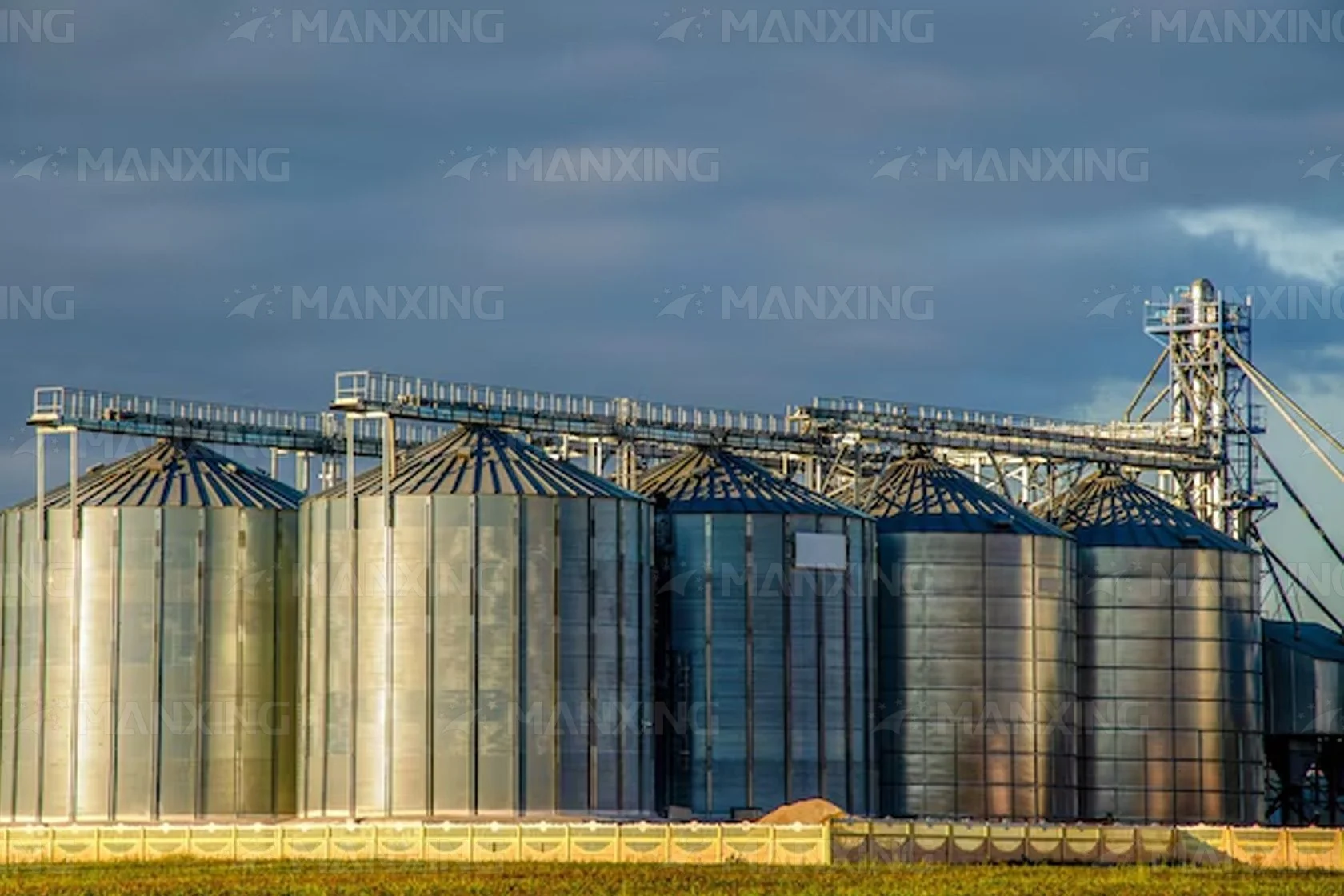
Why High-Moisture Corn and Specialty Grains Demand Unique Design
Storing high-moisture corn (above 15% moisture) and specialty grains such as organic or non-GMO varieties presents challenges not addressed by standard silo designs. High-moisture corn is prone to mold and heating if not aerated aggressively, while specialty grains require segregation and gentle handling to preserve quality and certification. A one-size-fits-all approach leads to spoilage, quality loss, and economic penalties.
Aeration System Design for High-Moisture Conditions
For high-moisture corn (18–25% moisture), ASABE EP475 recommends airflow rates of 1.0 to 2.0 cfm/bu for natural air drying, increasing to 2–3 cfm/bu for longer-term storage. Specialty grains like organic corn (typically stored at 13–14% moisture) need lower airflow (0.5–1.0 cfm/bu) but must avoid contamination from non-organic residues.
- Static pressure: For a 5000-bushel bin with 2 cfm/bu, total airflow is 10,000 cfm. Using MWPS-29, static pressure at 2 cfm/bu is ~0.5 inches of water gauge for a 20-foot deep bin. Select a fan rated for 10,000 cfm at 0.5 in. w.g.
- Duct layout: Fully perforated floors are essential for high-moisture corn to ensure even airflow. For specialty grains, partial floors (e.g., 50% perforation) may suffice but risk dead zones.
- Fan type: Centrifugal fans handle higher static pressures better than axial fans for deep bins. Variable-speed drives allow adjustment for different moisture content.
Temperature Monitoring for Grain Quality Preservation
Temperature cables should be placed at 8–10 ft horizontal spacing and at three vertical levels: near the bin wall, mid-radius, and center. For high-moisture corn, scan intervals of every 6 hours during the first two weeks of storage, then daily. Specialty grains require weekly checks unless a temperature rise of 5°F per day is detected—triggering immediate aeration.
- Wireless sensors reduce installation cost but require power; cable systems are more reliable in dusty environments.
- Alarm thresholds: Set at 95°F for high-moisture corn (risk of mold), and 85°F for specialty grains (to preserve germination or nutritional quality).
- Integration: Connect sensors to a PLC that automatically activates fans when temperature exceeds setpoint by 3°F.
Handling Equipment for Fragile Specialty Grains
Specialty grains (e.g., organic quinoa, non-GMO soybeans) are more susceptible to breakage than commodity corn. Belt conveyors are preferred over screw augers, as they reduce impact and abrasion. Drop heights should be limited to 10 ft, with cushioned transitions at transfer points.
- Drag chain conveyors offer gentle handling but have higher maintenance. For retrofits, replace existing augers with belt conveyors.
- Cleaning: Pre-cleaners with aspiration remove fines and reduce mold risk. Dedusting systems (cyclones or bag filters) are essential for organic grains to avoid cross-contamination.
Case Study: Retrofitting a 10,000-Bushel Bin for Organic Corn
A facility in Iowa converted a standard bin for organic corn storage. Before retrofit: airflow was 0.3 cfm/bu with a partially perforated floor, leading to 5% spoilage. After: installed a fully perforated floor, a 20,000 cfm centrifugal fan, and six temperature cables. After one year, spoilage dropped to <1%, and organic certification was maintained. Key lesson: dedicated equipment for specialty grains avoids cross-contamination.
Design Checklist for Engineers and Facility Managers
- Determine target moisture content and airflow rate per ASABE EP475.
- Calculate total airflow and static pressure using MWPS-29.
- Select fan with variable-speed drive for flexibility.
- Install fully perforated floor for high-moisture corn; consider partial for dry specialty grains.
- Place temperature sensors at 8–10 ft spacing, three levels, with daily monitoring.
- Use belt conveyors with low drop heights for fragile grains.
- Include cleaning and dedusting equipment for organic certification.
Frequently Asked Questions
- What is the minimum airflow for high-moisture corn? At 20% moisture, 2 cfm/bu for drying; for storage up to 6 months, 1 cfm/bu is minimum.
- Can I use a standard bin for specialty grains? Yes, but only after thorough cleaning and retrofitting with dedicated handling equipment to avoid contamination.
- How often should I monitor temperature? Daily for the first two weeks, then weekly; increase frequency if temperature rises more than 3°F per day.
Designing a grain silo system for high-moisture corn and specialty grains requires careful attention to aeration, temperature monitoring, and handling equipment. By following these engineering guidelines, you can preserve grain quality and avoid costly spoilage. For a downloadable PDF checklist, contact our team.
Table of Contents
PDF
Download File
Manxing Silo Brochure
Manxing_Silo_Brochure.pdf
Open the download form to unlock this file. The download will start automatically after submission.
Request a Quote
We are committed to providing you with exceptional service and ensuring a seamless buying experience. Please send us your inquiry, and we will respond with a detailed quotation.